Posts

KEY TERMS OF MANAGEMENT FROM SCANDINAVIAN STUDIES TO COMMUNICATION NETWORK

Image
1.       Scandinavian Studies  -         Development-oriented leader:  A leader who is willing to take risks, experiments, and develops new ideas to accomplish goals. 2.        Contingency Theories of Leadership  -         Fiedler contingency model:  States that effective groups require a match between a leader’s style and his or her subordinates’ personalities .  3.      Cognitive resource theory :  States that by first making plans, decisions, and strategy, a leader’s effectiveness is enhanced.  4.      Hersey and Blanchard’s Situational Theory :  States that leadership effectiveness is greatly influenced by subordinates’ readiness.      Leader-Member Exchange Theory :  States that leaders form “in” and “out” groups and that individuals in the “in” gr...
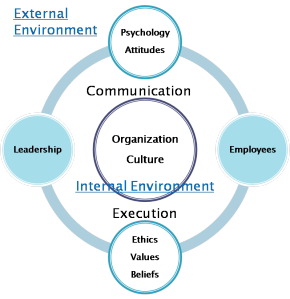
ORGANIZATIONAL EFFECTIVENESS THROUGH ORGANIZATION CULUTRE

Image
organization culture is an important determinant of how well the organization will perform. Every organization seeks to be more effective and achieve better results; a careful business strategy is developed to achieve this. However, successful execution of the strategy occurs when structure, roles, capability, leadership, people management systems and organizational culture change are all aligned to the strategy. So , Organizational culture is a system of shared values and beliefs about what’s important and appropriate in an organization; it also includes feelings and relationships internally and externally. Every organization’s values are supposed to be unique and are widely shared and reflected in daily practice, relevant to the company purpose and strategy. It’s important for organizations of different size and level to create the kind of environment or culture where the positive managerial patterns of listening, coaching, guiding, involving and problem-solving are actively encou...

KEY TERMS OF MANAGEMENT FROM DELEGATION TO MANAGERIAL GRID

Image
1.      Delegation :  The transfer of authority from a manager to a subordinate.  2.      Span of management :  The number of employees reporting to a manager.  Also known as span of control.  3.      Centralization :  Decision authority is concentrated at the top of the organizational  hierarchy.  4.      Decentralization:   Upper management pushes decision-making authority to lower organizational levels.  5.       Tall structure :  Characterized by a large number of hierarchical levels and a relatively narrow span of management.  6.      Flat structure :  Characterized by few hierarchical levels and a broad span of management. 7.      Organizational change:   The adoption and implementation of innovations and new behaviors by an organization. 8.   ...

10 WAYS TO IMPROVE THE COMMUNICATION EFFECTIVENESS

The word communication has been derived from the Latin word 'Communis' which means 'common'. Thus, communication means sharing of ideas in common. "When we communication," says Wibur Schramn , "We are trying to establish a 'commonness' with someone. That is we are trying to share information, an idea or an attitude. The essence of communication is getting the receiver and the sender 'turned' together for a particular massage Louis A, Allen defines communication as, "communication is the sum of all the things one person does when he wants to create understanding in the mind of another. It is a bridge of meaning. It involves a systematic and continuous process of telling, listening and understanding." Making communication effective or overcoming / gate ways to communication 1)      Clarity and Completeness: In communication effectively, it is very essential to know the 'audience' for whom the message is mean...

11 TYPES OF COMMUNICATION BARRIERS

Communication is the nerve system of an enterprise. It is said to be no. 1 management problem today. "It serves as the lubricant, fostering for the smooth operations of management process. 1)      Physical Barriers: A communication is two-way process, distance between the sender and the receiver of the message is an important barrier to communication. Noise and environmental factors also block communication. 2)      Personal Barriers: Personal factors like difference in judgement, social values, inferiority complex, bias, attitude, pressure of time, inability to communicate, etc. widen the psychological distance between the communicator and the communicate. Credibility gap, i.e., inconsistency between what one says and what one does, also, acts as a barrier to communication. 3)      Semantic or Language Barriers: Semantic is the science of meaning. The same work and symbols carry different meanings to different people...