Posts

Theoretical and Descriptive Analysis: BOP as a Monetary Phenomenon
Image
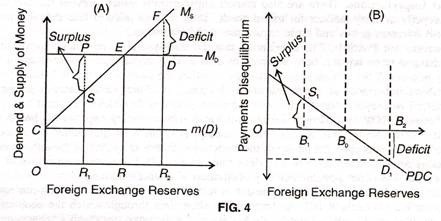
A balance of payments (BOP) deficit or surplus represents a transient stock adjustment process evoked by initial inequality between actual; and desired money stock. The monetary approach maintains that the BOP are essentially a monetary phenomenon and the root cause in the payments imbalances are the disequilibrium between the demand for and supply of money. This proposition is often called strong version of the monetary approach. As the Elasticity and Absorption approaches fail to provide the correcting measures of balance of payments deficit in the less developing countries; another approach is still available which is known as the Monetary Approach to the Balance of Payments. According to the monetary approach, the balance of payments is purely a monetary phenomenon. Being a monetary phenomenon, it can be corrected only through the monetary measures. According to the monetary approach, the balance of payments is a monetary phenomenon is related to inflow and outflow of internati...
TEN MANAGEMENT ROLES

Image
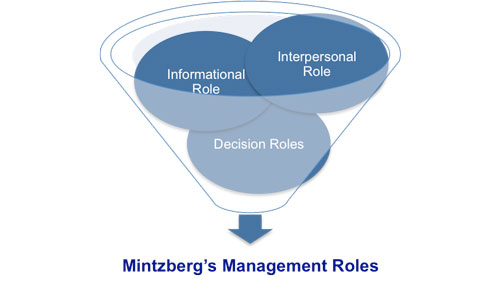
As a manager, you probably fulfill many different roles every day. For instance, as well as leading your team, you might find yourself resolving a conflict, negotiating new contracts, representing your department at a board meeting, or approving a request for a new computer system. Henry Mintzberg argued that there are ten primary roles or behaviors that can be used to categorize a manager's different functions. In this article we'll examine these roles, and we'll see how you can use your understanding of them to improve your management skills. The Roles Mintzberg published his Ten Management Roles in his book, "Mintzberg on Management: Inside our Strange World of Organizations," in 1990. The ten roles are:( FLL - MDS -   EDRN ) 1.      Figurehead. 2.      Leader. 3.      Liaison. 4.      Monitor. 5.      Disseminator. 6.      Spokesperson. 7...

COVID-19 Impact on Foreign Exchange Reserves and Policy Response of Nepal

Image
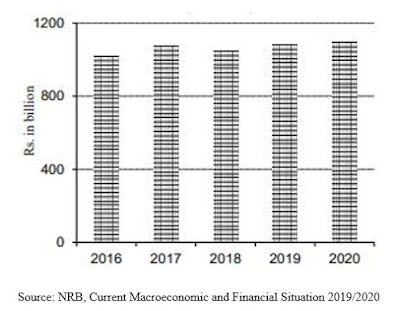
Before the global health crisis began , banks usually had a surplus foreign exchange on account of remittance which makes up more than 26 % of the GDP. They had extra funds which they sold to the central bank after fulling their market requirements. The central banks maintain foreign exchange based on the funds received from all banks and financial institutions. For instance if banks are not receiving sufficient foreign exchange reserves from tourism, export, and other factors of external sectors due to the decrease in the inflow of remittance. Then there will be low selling foreign exchange to the central bank by commercial banks. Since, Nepal is heavily dependent on the import of a number of essential goods such as food items, medicine, and petroleum products. With COVID-19 and recent lockdown across the globe, there is a rapid slowdown in foreign exchange into the nation. The inflow to go down further until the situation improves. As a result there will be a hard hit in the reserve...

Money Supply and its Determinants

Image
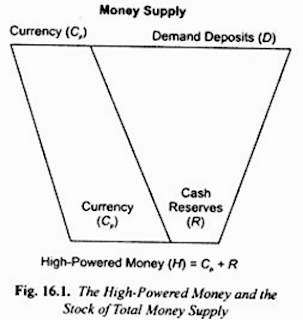
Introduction    The supply of money is a stock at a particular point of time, though it conveys the idea of a flow over time. The term ‘ the supply of money’ is synonymous with such terms as ‘ money stock’, ‘stock of money’, ‘money supply’ and ‘quantity of money’ . The supply of money at any moment is the total amount of money in the economy . There are three alternative views regarding the definition or measures of money supply. ·          The most common view is associated with the traditional and Keynesian thinking which stresses the medium of exchange function of money. Forms of MS M1 = C + DD    (Demand Deposit) M2= M1 +TD (Time Deposit) M3= M2 + Liabilities of NBAFI Determinant of MS 1. High powered Money (H= C + R), (M = C + D) The H Theory of Money Supply’. However, it is more popularly called ‘Money-multiplier Theory of Money Supply’ because it explains the determination of money supply as ...

IMPACT OF THE PRODUCT LIFE CYCLE ON A COMPANY'S CASH FLOWS

Image
Impact of the corporate life cycle on a company’s cash flows  All the product go through a series of phases called the product life cycle .The phases are :introductory phase , growth phase , maturity phase and decline phase .The introductory phase occurs at the beginning of a company’s life, when it is purchasing fixed assets and beginning to produce and sell products. During the growth phase, the company is striving to expand its production and sales. In the maturity phase, sales and production level off. During the decline phase, sales of the product fall due to weakening in consumer demand. As in the following diagram, the phase a company is in effects its cash flows.   In the first phase, we expect that the company will not be generating positive cash from operations. That is, cash used in operations will exceed cash generated by operations in the introductory phase .Also; the company will be spending considerable amounts to purchase productive assets such as b...

FUNDS FLOW STATEMENT Vs CASH FLOW STATEMENT

Image
Funds flow statement Vs Cash flow statement The differences are as follows: Funds flow statement Cash flow statement 1. It is based on accrual accounting system. 1. While preparation of this statement, all transaction effecting the cash and cash equivalents are taken into consideration. 2. It analysis the sources and application of funds of long-term nature and net increase or decrease in long term funds will be reflected on working capital of the firm, 2. It considers only the increase or decrease in current assets and current liabilities in calculating the cash flow from operations. 3. More useful in long range planning. 3. More useful for identifying and correcting the current liquidity problems of the firm. 4.Sound fund position does not necessarily mean sound cash operation 4. Sound cash operation is always followed by sound fund position. 5. It shows the funds generated a...